
UNITED STATES
SECURITIES AND EXCHANGE COMMISSION
Washington, D.C. 20549
Form 6-K
REPORT OF FOREIGN PRIVATE ISSUER PURSUANT TO RULE 13a-16 OR 15d-16 UNDER THE SECURITIES EXCHANGE ACT OF 1934
Date of Report: June 2, 2026
Commission File Number: 001-39307
Legend Biotech Corporation
(Translation of registrant's name into English)
2101 Cottontail Lane
Somerset, New Jersey 08873
(Address of principal executive office)
Indicate by check mark whether the registrant files or will file annual reports under cover of Form 20-F or Form 40-F.
Form 20-F [ X ] Form 40-F [ ]
Legend Biotech Announces Late-Breaking Oral Presentation at EHA 2026
On June 2, 2026, Legend Biotech Corporation (“Legend Biotech”) announced that promising preliminary clinical data for LB2501, its investigational in vivo CD19/CD20 dual-targeting CAR-T cell therapy, in patients with relapsed/refractory B-cell non-Hodgkin lymphoma (R/R B-NHL), will be presented during a late-breaking session at the European Hematology Association (“EHA”) 2026 Congress, taking place June 11-14, 2026, in Stockholm, Sweden.
The press release is attached to this Form 6-K as Exhibit 99.1.
The EHA abstract #7249 is attached to this Form 6-K as Exhibit 99.2. Exhibit 99.2 to this report is being furnished and shall not be deemed “filed” for purposes of Section 18 of the Securities Exchange Act of 1934, as amended (the “Exchange Act”), or otherwise subject to the liabilities of that Section, nor shall it be deemed incorporated by reference in any filing under the Securities Act of 1933, as amended, or the Exchange Act, except as expressly set forth by specific reference in such a filing.
The information contained in this Form 6-K, but excluding Exhibit 99.2, is hereby incorporated herein by reference in the registration statements of Legend Biotech on Form F-3 (Nos. 333-278050, 333-272222, and 333-257625) and Form S-8 (No. 333-239478 and 333-283217), to the extent not superseded by documents or reports subsequently filed.
EXHIBIT INDEX
| Exhibit | Title | |||
| 99.1 | Press Release dated June 2, 2026 | |||
| 99.2 | EHA Abstract, dated June 2, 2026 |
SIGNATURES
Pursuant to the requirements of the Securities Exchange Act of 1934, the registrant has duly caused this report to be signed on its behalf by the undersigned, thereunto duly authorized.
| Legend Biotech Corporation | ||
| (Registrant) | ||
| Date: June 2, 2026 | /s/ Ying Huang | |
| Ying Huang, Ph.D. | ||
| Chief Executive Officer | ||
EXHIBIT 99.1
Legend Biotech Announces Late-Breaking Oral Presentation at EHA 2026 Showcasing Initial Phase 1 In Vivo CAR-T Data with LB2501 in Non-Hodgkin Lymphoma (NHL)
- Promising Phase 1 data for LB2501, a potential first‑in‑class CD19/CD20 dual‑targeting in vivo CAR-T therapy, as an off-the-shelf, single-infusion treatment for B‑cell malignancies
- An ORR of 100% (6/6) was observed in the dose level 2 cohort, including CR rate of 83.3% (5/6) in patients with relapsed/ refractory NHL
- Data demonstrate robust in vivo CAR-T expansion without lymphodepleting chemotherapy
- Favorable safety profile: no DLTs, no SAEs, no ICANS, CRS <Grade 2
BRIDGEWATER, N.J., June 02, 2026 (GLOBE NEWSWIRE) -- Legend Biotech Corporation (NASDAQ: LEGN) (Legend Biotech or the Company), a global leader in cell therapy, today announced that promising preliminary clinical data for LB2501, its investigational in vivo CD19/CD20 dual-targeting CAR-T cell therapy, in patients with relapsed/refractory B-cell non-Hodgkin lymphoma (R/R B-NHL), will be presented during a late-breaking session at the European Hematology Association (EHA) 2026 Congress, taking place June 11-14, 2026, in Stockholm, Sweden.
“The upcoming presentation of Phase 1 LB2501 data in patients with B-cell malignancies represents an important step in advancing in vivo CAR-T approaches,” said Ying Huang, Ph.D., Chief Executive Officer of Legend Biotech. “By generating CAR-T cells directly within the patient, this approach has the potential to simplify treatment delivery and expand access for patients who may not be able to receive traditional CAR-T cell therapies. LB2501 is built on the TaVec™ platform, which is a proprietary lentiviral vector engineered to enhance T-cell specificity, transduction efficiency, and safety, while restricting transduction of non-T cells.”
LB2501: Promising Phase 1 Trial of In Vivo CAR-T Data Demonstrate High Response Rates in B-cell Malignancies
Data from 12 patients across two dose cohorts in an ongoing Phase 1 study evaluating LB2501 in patients with R/R B-NHL provide early clinical evidence supporting the potential of an in vivo CAR-T approach in B-cell malignancies. LB2501 is designed to generate CAR-T cells directly within the patient following a single intravenous infusion, eliminating the need for cell manufacturing and lymphodepletion.
As of April 1, 2026, 12 patients with R/R B-NHL were treated across two dose levels (DL1 and DL2). Additional details will be presented at EHA 2026. Key findings from the abstract include:
Efficacy Results
- At DL2 (median follow-up for DL2 was 2.2 months [range, 2.0 to 3.8])
- Objective response rate (ORR): 100% (6/6)
- Complete response rate (CR): 83.3% (5/6)
- All responses were ongoing at data cutoff
Pharmacokinetics
- Dose-dependent in vivo CAR-T expansion observed
- CAR-T cells detected in peripheral blood for up to 116 days
Safety Results
- No dose-limiting toxicities (DLTs), serious adverse events (SAEs), or deaths were observed
- Infusion-related reactions occurred in 75% of patients, all of which were ≤ Grade 2
- Cytokine release syndrome (CRS) occurred in 66.7% of patients, all of which were ≤ Grade 2
- No immune effector cell-associated neurotoxicity syndrome (ICANS) was reported
- Grade ≥3 lentiviral vector-related and CAR-T-related adverse events were limited to decreased lymphocyte count and decreased neutrophil count
EHA Presentation (June 11-14, 2026)
| Abstract No. | Title | Information |
| Abstract #LB5006 Late-Breaking Oral Presentation | First-in-human trial of LB2501, an in vivo CD19/CD20 dual targeting CAR-T therapy, in relapsed/refractory B-Cell NHL | Session ID: s204 Date/Time: Sunday, June 14, 2026, 9:15-10:45 AM CEST Location: Nobel Hall |
ABOUT LB2501
LB2501 is an investigational, potential first-in-class CD19/CD20 dual-targeting in vivo CAR-T therapy designed to generate CAR-T cells directly within the patient following a single intravenous infusion. It is being evaluated in an ongoing Phase 1, open-label study NCT07002112) in patients with relapsed/refractory B-cell malignancies to assess safety, tolerability, and preliminary efficacy.i
ABOUT B-CELL NON-HODGKIN LYMPHOMA
Non-Hodgkin lymphoma (NHL) is a group of cancers that originate in lymphocytes, a type of white blood cell that plays a key role in the body’s immune system.ii B-cell lymphomas account for approximately 85% of NHL cases and arise from abnormal growth of B lymphocytes (B cells), which are responsible for producing antibodies. These malignancies include a range of subtypes that vary in aggressiveness, from slow-growing to highly aggressive disease.iii
ABOUT LEGEND BIOTECH
With over 3,000 employees, Legend Biotech is the largest standalone cell therapy company and a pioneer in treatments that change cancer care forever. Legend Biotech is at the forefront of the CAR-T cell therapy revolution with CARVYKTI®, a one-time treatment for relapsed or refractory multiple myeloma, which it develops and markets with collaborator Johnson & Johnson. Centered in the United States, Legend Biotech is building an end-to-end cell therapy company by expanding its leadership to maximize CARVYKTI’s patient access and therapeutic potential. From this platform, Legend Biotech plans to drive future innovation across its pipeline of cutting-edge cell therapy modalities.
Learn more at https://legendbiotech.com and follow us on X, Instagram, and LinkedIn.
CAUTIONARY NOTE REGARDING FORWARD-LOOKING STATEMENTS
Statements in this press release about future expectations, plans, and prospects, as well as any other statements regarding matters that are not historical facts, constitute “forward-looking statements” within the meaning of The Private Securities Litigation Reform Act of 1995. These statements include, but are not limited to, statements relating to Legend Biotech’s strategies and objectives, the potential benefits of the proprietary TaVec platform, the Phase 1 clinical trial of LB2501 and the potential benefits of LB2501, including its potential to be first-in-class. The words “anticipate,” “believe,” “continue,” “could,” “estimate,” “expect,” “intend,” “may,” “plan,” “potential,” “predict,” “project,” “should,” “target,” “will,” “would” and similar expressions are intended to identify forward-looking statements, although not all forward-looking statements contain these identifying words. Actual results may differ materially from those indicated by such forward-looking statements as a result of various important factors. Legend Biotech’s expectations could be affected by, among other things, uncertainties involved in the development of new pharmaceutical products; unexpected clinical trial results, including as a result of additional analysis of existing clinical data or unexpected new clinical data; unexpected regulatory actions or delays, including requests for additional safety and/or efficacy data or analysis of data, or government regulation generally; unexpected delays as a result of actions undertaken, or failures to act, by Legend Biotech’s third-party partners; uncertainties arising from challenges to Legend Biotech’s patent or other proprietary intellectual property protection, including the uncertainties involved in the U.S. litigation process; government, industry, and general product pricing and other political pressures; as well as the other factors discussed in the “Risk Factors” section of Legend Biotech’s Annual Report on Form 20-F filed with the Securities and Exchange Commission on March 10, 2026. Should one or more of these risks or uncertainties materialize, or should underlying assumptions prove incorrect, actual results may vary materially from those described in this press release as anticipated, believed, estimated, or expected. Any forward-looking statements contained in this press release speak only as of the date of this press release. Legend Biotech specifically disclaims any obligation to update any forward-looking statement, whether as a result of new information, future events, or otherwise.
INVESTOR CONTACT:
Jessie Yeung
Tel: (732) 956-8271
investor@legendbiotech.com
PRESS CONTACT:
Kim Fox
Tel: (848) 388-8445
media@legendbiotech.com
i ClinicalTrials.Gov. The CD19/CD20 Dual-Target in Vivo CAR-T Lentiviral Product in the Treatment of Relapsed/Refractory B-cell Malignancies. https://clinicaltrials.gov/study/NCT07002112. Accessed May 2026
ii American Cancer Society. “What Is Non-Hodgkin Lymphoma?”. Available at: https://www.cancer.org/cancer/types/non-hodgkin-lymphoma/about/what-is-non-hodgkin-lymphoma.html.Accessed May 2026.
iii American Cancer Society. “Types of B-cell Lymphoma.” Available at: https://www.cancer.org/cancer/types/non-hodgkin-lymphoma/about/b-cell-lymphoma.html.Accessed May 2026.
EXHIBIT 99.2
Topic: 26. Gene therapy, cellular immunotherapy and vaccination - Clinical
EHA-7249
First-in-human trial of LB2501, an in vivo CD19/CD20 dual targeting CAR-T therapy, in relapsed/refractory B-Cell NHL
Type: None selected
Xiaoyan Qu1 Yajing Zhang2 Haisheng Liu3 Heng Mei4 Kaiyang Ding5 Jujuan Wang1 Sanmei Wang1 Haorui Shen1 Zhengxu Sun1 Shuangshuang Xing1 Guoai Su2 Zheng Li3 Lin Liu4 Ran Li1 Hailing Liu1 Ling Zhou6 Yinrui Jiang6 Yongxin Luo6 Baoming Ni7 Dong Geng7 Guowei Fang7 Yanjie Xu6 Cong Feng6 Wenjie Wang6 Da Xu6 Zhongyuan Tu6 Hongchen Zheng6 Bing Gao6 Jin Liu6 Lei Fan1
1 The First Affiliated Hospital of Nanjing Medical University, Department of Hematology, Nanjing, China, 2 Beijing GoBroad Boren Hospital, Gobroad Medical Institute of Hematology, Department of Myeloma and Lymphoma, Beijing, China, 3 The Fourth Hospital of Hebei Medical University, Shijiazhuang, China, 4 Union Hospital, Tongji Medical College, Huazhong University of Science and Technology, Institute of Hematology, Wuhan, China, 5 The First Affiliated Hospital of USTC Anhui Provincial Hospital, Department of Hematology, Hefei, China, 6 Legend Biotech Co, Nanjing, China, 7 Legend Biotech USA Inc, Somerset, NJ, United States of America
Background
Ex vivo CAR-T therapies have advanced treatment for relapsed/refractory non-Hodgkin lymphoma (R/R NHL) but are limited by complex manufacturing and lymphodepletion. In vivo CAR-T offers an off-the-shelf alternative that generates CAR-T cells directly in patients without requiring lymphodepletion. While feasibility has been shown in multiple myeloma, clinical data for B-cell malignancies remain unreported. LB2501, a third-generation, replication-incompetent lentiviral vector (LVV) pseudotyped with a modified fusion glycoprotein and a CD3 binder for T-cell-specific transduction, encodes a CD19/CD20 dual targeting CAR to generate CAR-T in vivo.
Aims
To evaluate the safety, pharmacokinetics, and preliminary efficacy of LB2501 in R/R B-NHL.
Methods
This ongoing phase 1 trial (NCT07002112) enrolled patients with measurable R/R NHL who had primary refractory disease or progression after ≥2 prior lines of therapy. A 3+3 dose-escalation design with backfilling was used across dose levels (DLs). LB2501 was administered as a single intravenous infusion without lymphodepletion.
Results
As of April 1, 2026, 12 patients had been dosed with LB2501 at DL1 (n=6) or DL2 (n=6). The median age was 58.5 years, median prior therapy lines was 3, and 58.3% were refractory to last line. Patients included 7 (58.3%) LBCL, 3 (25%) FL and 2 (16.7%) MCL. No DLT, SAE or fatal cases were reported. Infusion-related reactions occurred in 9 patients (75.0%); all were grade 1 or 2, resolved within a median of 2.0 days, and required no tocilizumab or glucocorticoids. Cytokine release syndrome (CRS) occurred in 66.7% patients (grade 1 in 58.3%, grade 2 in 8.3%); No neurotoxicity (ICANS) was observed. Grade≥3 LVV-related and CAR-T-related adverse events were limited to decreased lymphocyte count (33.3% each) and decreased neutrophil count (25.0% and 50.0%, respectively). The objective response rate (ORR) was 50% (6/12), with a complete response rate (CR) of 41.7% (5/12). At DL2, the ORR was 100% (6/6) and the CR was 83.3% (5/6). All responses were ongoing at cut-off date (Figure 1). The median follow-up for DL2 was 2.2 months (range, 2.0 to 3.8). PK analysis via qPCR confirmed dose-dependent in vivo CAR-T cell expansion in 83% (5/6) of patients at DL1 and 100% (6/6) at DL2. At DL2, the median Cmax was 109,117.5 copies/μg DNA (vs. 1,068.0 at DL1), with a median Tmax of 15.0 days. At the time of data cutoff, patients exhibited persistent PK, with CAR-T cells detectable in peripheral blood for up to 116 days. Insertion site analyses indicate in vivo transduction is highly T cell specific, polyclonal, and diverse with mostly single copy insertion per T cell. The median VCN for in vivo CAR-T was 1.05, lower than ex vivo manufactured CAR-T.
Summary/Conclusion
This study represents the initial clinical cohort of in vivo CAR-T therapy in relapsed/refractory non-Hodgkin lymphoma. LB2501, a first-in-class CD19/CD20 dual-targeting in vivo vector, introduces a novel paradigm by eliminating the need for ex vivo manufacturing and lymphodepletion. LB2501 has demonstrated a favorable safety profile and encouraging efficacy with a 100% ORR and 83.3% CR at DL2. While a longer-follow up is warranted, these data highlight the potential of LB2501 as a scalable, readily accessible “off-the-shelf” immunotherapy for B-cell malignancies.
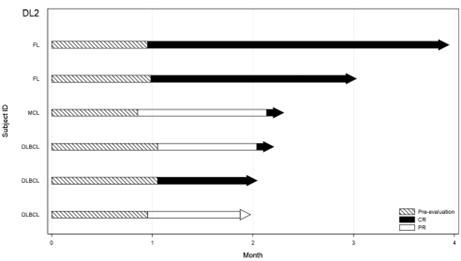
Figure 1: Patient Responses to DL2